
By now, most leaders have heard the pitch: Artificial Intelligence is transforming operations. Generative AI will reshape your product. You need an AI strategy, and you need it now.
But for many decision-makers, the honest internal question is still the same: where do we actually start?
What does Artificial Intelligence genuinely mean for a business at your stage? Which use cases create durable leverage versus short-lived hype? And what separates companies that build real AI capabilities from those that spend a year running pilots that never reach production?
This article answers those questions directly. It defines AI and generative AI in terms that matter operationally, maps the landscape of what is actually possible across different disciplines, and lays out what a grounded AI strategy looks like for organizations ready to move from curiosity to execution.
Along the way, it connects to specific technical and product perspectives from our team, because the ideas only become useful when they connect to how real systems get built.
What is AI? The definition that holds up under operational scrutiny
Artificial intelligence is the development of systems capable of performing tasks that typically require human cognition, recognizing patterns, understanding language, generating content, making decisions based on data, and adapting behavior over time.
Let’s take a more complex explanation of each of the domains of AI:
Machine Learning
Machine learning is the discipline in which systems improve their performance by learning from data, without being explicitly reprogrammed for each scenario. Instead of following rules written by developers, a machine learning system derives its own internal logic by analyzing examples and optimizing against a defined objective.
This shift, from rule-based logic to data-driven, adaptive behavior, is what makes ML the foundation of modern AI systems. Search engines rank results using it. Banks detect fraud with it in milliseconds. Healthcare platforms apply it to improve diagnostic precision. SaaS products embed it into recommendation engines and intelligent workflows.
For organizations building AI-powered products, machine learning is structural infrastructure, not a feature. Understanding the lifecycle, from data preparation and model training through evaluation, deployment, and continuous monitoring, is essential for any leader who will be making investment decisions about AI.
Natural Language Processing (NLP)
Natural language processing (NLP) is the capability that allows machines to read, interpret, and generate human language. NLP is the foundation of chatbots, document summarization, contract analysis, voice interfaces, and the semantic search that now powers modern enterprise software.
As a standalone discipline, NLP delivered significant value for years before generative AI made it mainstream. The distinction matters strategically: not every language-processing use case requires a large language model. Sometimes a well-trained classification model or a lightweight summarization pipeline is the right tool — and significantly cheaper to run at scale.
Computer Vision
Computer vision enables systems to analyze and interpret visual inputs. Applications range from quality control on manufacturing lines and infrastructure inspection to medical imaging analysis and real-time monitoring systems. For companies in physical industries, computer vision is often the highest-leverage AI application that receives the least strategic attention.
Generative AI
Generative AI refers to large-scale models trained to produce new outputs like text, code, images, audio, and structured data, rather than classify existing data. This is the branch that has captured the most business attention over the past three years, and with good reason. But it requires its own section.
Read more: AI & Machine Learning Glossary: Key Terms for Modern Businesses
What is Generative AI and why does it change the business calculus?
Generative AI encompasses large language models (LLMs), systems like GPT, Claude, and Gemini, trained on vast corpora to understand and produce language at a level of quality that, until recently, was not computationally feasible outside research settings.
What makes it commercially transformative is capability and accessibility. Business teams can now trigger sophisticated AI behavior through plain language prompts, without custom model training, without large data science teams, and without years of R&D investment. That compression of the path from idea to working software has changed what is achievable for companies at every scale.
For businesses, generative AI creates three concrete categories of opportunity:
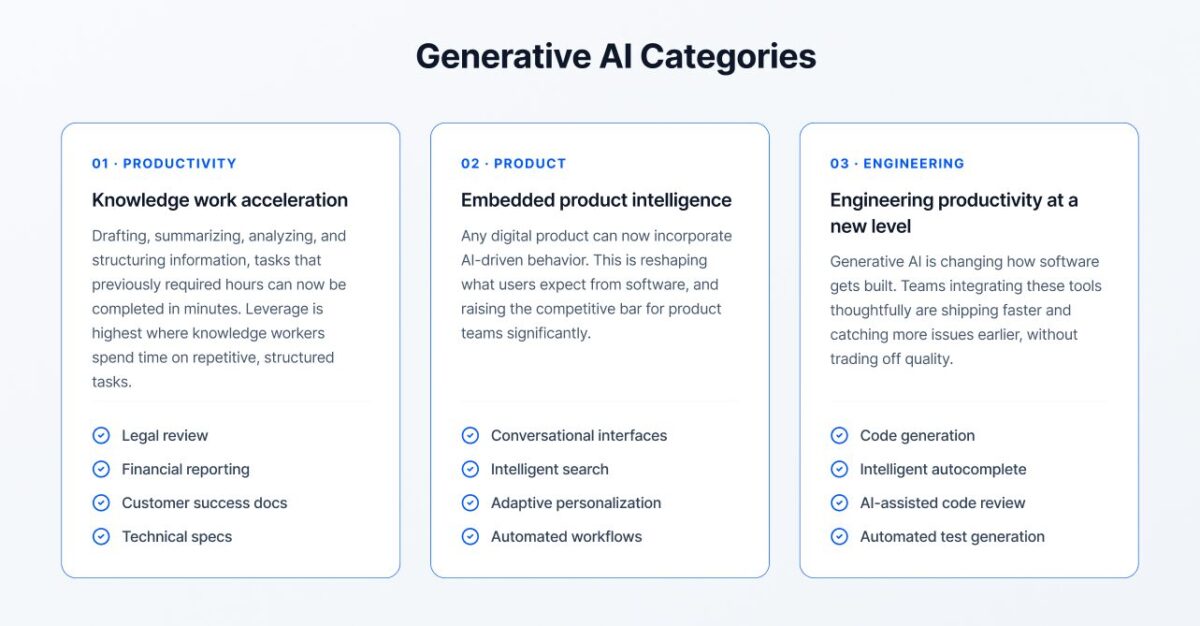
LLMs can produce inconsistent outputs without proper engineering guardrails. They introduce governance and compliance challenges that most organizations are not yet equipped to handle. Generative AI is powerful but it demands the same rigor as any production software system, and in some ways more.
Artificial Intelligence: Where are we at this point?
The gap between organizations that treat AI as a long-term experiment and those that are shipping AI-powered products in production is widening — and the pace of change in the underlying technology is a big reason why.
According to Epoch AI’s Trends in Artificial Intelligence dashboard, updated in February 2026, the numbers are striking:
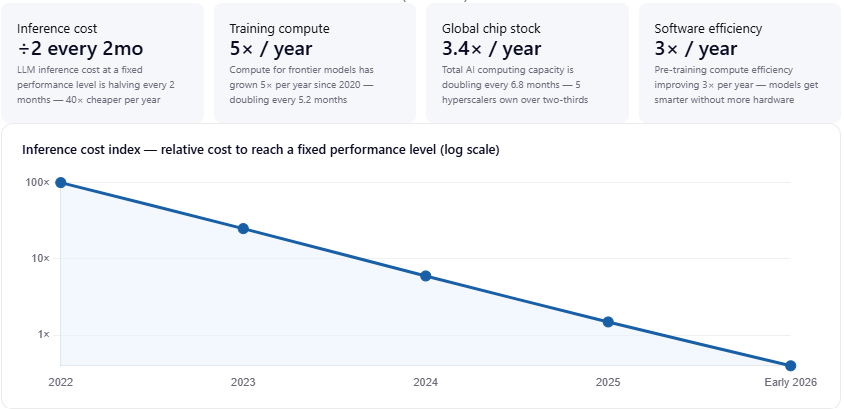
Source: Epoch AI, Trends in Artificial Intelligence, accessed Aug. 14, 2026. Largest known AI data center: 1.1 million H100-equivalent chips. Epoch updates this dashboard continuously, so the current figure may be higher.
The cost to run AI is collapsing. Epoch AI estimates that the cost of reaching a given capability level falls very roughly 5x to 10x per year. Running the same AI capability today costs something like five to ten times less than it did a year ago. Products that were economically unviable in 2023 are now straightforward to ship.
Training compute is compounding. Compute used to train frontier models has grown 5x per year since 2020, doubling every 5.2 months. The models available to build on top of are getting significantly more capable on a schedule that has not slowed down.
Infrastructure is scaling in parallel. Global AI computing capacity is growing 3.4x per year, with five hyperscalers now controlling over two-thirds of total capacity. The hardware foundation for AI deployment at scale exists and is expanding rapidly.
Software efficiency is amplifying everything. Pre-training compute efficiency is improving at roughly 3× per year — meaning models are getting smarter even without additional hardware investment. Better algorithms are doing more with less.
What this means practically: the window between “this AI use case is technically feasible” and “this AI use case is economically feasible and in production” is compressing. Organizations that are still in planning mode are making decisions against a cost and capability baseline that is already out of date.
AI and Product Design: The creative layer is changing too
It is worth addressing one dimension that often gets left out of AI strategy conversations focused on operations and engineering: the product design layer.
AI is not just changing what products can do. It is changing how products are designed and prototyped. Teams are now using AI to generate interface variations, test user flows at speed, and compress the distance between concept and testable prototype. That shift has significant implications for how product and design teams work — and what leaders should expect in terms of iteration velocity and design quality.
Our design team documented what they learned firsthand when they spent time testing the current generation of AI prototyping tools in what we learned exploring AI prototyping tools. The findings are honest about both the genuine acceleration and the real limitations, which is precisely the kind of grounded perspective that should inform strategic decisions about where to invest in AI-assisted design workflows.
Beyond prototyping, generative AI is opening up new dimensions of product accessibility. AI-driven text-to-speech, content summarization, and multi-format delivery are allowing companies to serve broader audiences with the same content investment.
How AI is Turning Content Into a Multi-Format and Accessible Experience explores this in detail and it is worth reading for any product leader thinking about how AI can increase the reach and utility of digital products without proportionally increasing content production costs.

The failure mode no one talks about enough
The most common reason AI initiatives stall is not a technology problem. It is a strategy problem — specifically, starting with a technology and working backward to justify it.
“We need a chatbot.” “We want to integrate GPT into our platform.” “Our competitors are doing something with AI”
These are impulses, not strategies. And they lead to one of two outcomes: either the initiative never reaches production because the use case was never precisely defined, or it reaches production and fails to deliver measurable value because success was never specified.
The pattern is not new. The same mistake was made with big data, blockchain, and IoT. Every technology wave attracts initiatives built on enthusiasm rather than problem clarity. AI is different only in that the enthusiasm is more widespread and the speed of adoption has compressed the timeline for recognizing failure.
The companies that build durable AI capabilities approach the problem from the opposite direction. They start with a specific, high-cost operational or product problem — then ask whether AI is the right solution. Sometimes a simpler automation would deliver the same outcome at a fraction of the cost and complexity. The discipline to ask that question honestly is what separates AI strategy from AI theater.
The foundational question is not “what can we do with AI?” It is “what problem are we solving, and how will we know we’ve solved it?” Every AI initiative should begin there.
What is an AI Strategy? A framework that holds up under real conditions
An AI strategy is a structured plan for how your organization will develop, deploy, and govern AI capabilities to achieve specific business outcomes. It is not a list of tools, a POC roadmap, or a vendor selection process. It is a set of aligned decisions across five dimensions that, taken together, determine whether AI creates lasting value.
- Can you name the specific metric this AI capability will move?
- Does leadership review that metric regularly?
- Have you defined what “success” looks like in 90 days?
- Is there a baseline to measure improvement against?
- Is the relevant data accessible and consistently structured?
- Is it compliant with applicable privacy regulations?
- Have you assessed whether RAG or fine-tuning is the right retrieval approach?
- Who owns data quality accountability?
- Build from scratch → proprietary data + AI is core differentiator
- Integrate via API → fastest to market, most cost-effective
- Fine-tune → domain-specific accuracy without full training cost
- RAG → proprietary knowledge + LLM reasoning, no retraining required
- Prompt standards documented with version control
- Content safety guardrails at pre- and post-processing layers
- Model drift and output quality monitoring in production
- Clear accountability for AI-influenced decisions
- Defined graceful failure processes for unexpected behavior
- Engineering teams understand agent architecture and evaluation methodology
- Leadership owns AI outcomes with defined KPIs
- There is a clear escalation path when AI systems behave unexpectedly
- Access to external expertise for first-generation AI products
1. Business Alignment: Outcomes Before Everything
The practical starting point is identifying three to five high-cost problems in your organization where intelligent automation or AI-generated insight could create a material advantage. Rank them by potential impact and data readiness. This becomes your AI opportunity portfolio, and the basis for sequencing investment decisions.
A useful constraint: if you cannot draw a direct line from a proposed AI capability to a specific metric that your leadership team reviews regularly, the initiative is not ready to be resourced as a strategic priority.
2. Data Readiness: The Bottleneck Most Organizations Discover Late
Before investing in model development or product integration, a rigorous assessment of data infrastructure is required. Key questions: Is the relevant data accessible and consistently structured? Is it governed and compliant with applicable regulations, particularly for customer data and any domain subject to privacy law? Can it be used to power the intended AI application without significant transformation work?
Retrieval-augmented generation (RAG) has made it more feasible to use imperfect, unstructured enterprise data with LLMs, but it does not eliminate the need for data quality work. It changes the shape of the work, not its necessity.
Companies that invest in data infrastructure in parallel with AI strategy, rather than treating data readiness as a prerequisite that delays AI investment, consistently see higher returns from their AI programs.
3. Build vs. Integrate vs. Fine-tune: The decision with long-term consequences
One of the most consequential architectural decisions in AI strategy is how to acquire capability. The three primary models differ significantly in investment, timeline, and differentiation potential:
| Dimension | Build from scratch | Integrate via API | Fine-tune |
|---|---|---|---|
| Investment | Very high | Low to moderate | Moderate |
| Time to market | Months to years | Weeks to months | Weeks to months |
| Differentiation | Highest potential | Built in application layer | Domain-specific accuracy |
| Data requirement | Large proprietary dataset required | Minimal – uses base model knowledge | Curated domain-specific dataset |
| Maintenance burden | High – full MLOps required | Low – provider manages model | Medium – retraining cycles needed |
| Best for | AI is core product differentiator, unique proprietary data | Adding AI to existing products fast — most common case | Domain accuracy without full training cost |
4. Governance as a product requirement, not a compliance afterthought
Organizations that treat governance as a compliance exercise to complete after deployment consistently accumulate what is now being called AI technical debt — undocumented prompt logic, fragile evaluation pipelines, shadow AI workflows, and model behavior that nobody can explain or audit.
Governance built in from the start includes: documented prompt standards with version control, content safety and compliance guardrails applied pre- and post-processing, monitoring systems for model drift and output quality degradation, clear accountability for AI-influenced decisions that affect users or operations, and defined processes for graceful failure when systems behave unexpectedly.
There is also an important trust dimension that often gets overlooked: users need to understand what an AI system can and cannot do. Setting accurate mental models from the start, through UX decisions, transparency signals, and feedback mechanisms, is as much a governance practice as technical guardrails.
5. Organizational Readiness: The Capability That Compounds
Technology alone does not execute an AI strategy. The organizations that build the most durable AI capabilities share a common characteristic: they treat AI as a product and engineering discipline, not a research experiment.
That means product and engineering teams that understand AI-specific development patterns, not just LLM APIs, but evaluation methodology, context management, agent architecture, and failure mode design.
It means leadership that owns AI outcomes with the same accountability applied to any product initiative. And it means access to external expertise when internal knowledge has gaps — particularly for the first generation of AI products, where architectural decisions made early have consequences that compound over time.
Read more: Most Companies Aren’t Ready for AI Here’s How to Find Out Where You Actually Stand
Generative AI in practice: What happens when it meets real engineering
One of the most important and least discussed dimensions of AI strategy is what happens at the engineering layer when AI moves from prototype to production.
In a prototype, the impressive behavior of an LLM is easy to demonstrate. In production, you encounter the full complexity: context window management, latency constraints, token costs, non-deterministic outputs, evaluation difficulty, and the challenge of maintaining consistent behavior as base models are updated by their providers.
The teams shipping AI-powered products with real reliability are those that bring engineering discipline to AI development. This means structuring agent behavior through well-defined skills and workflows rather than monolithic prompt files.
Our engineering team’s piece on Agent skills: Stop stuffing workflows into your rules file captures this concretely: the move from fragile, overcrowded rules configurations toward modular, testable agent skill architectures that hold up under real-world conditions.
It also means building code review processes that account for AI-generated code’s specific failure modes, not just applying the same review heuristics used for human-written code.
And it means rethinking QA from the ground up. AI-driven testing is not just automated testing with a new layer, but it is a fundamentally different approach to building confidence in software behavior, and it requires different tooling, different evaluation frameworks, and different habits.
AI strategy in the Mobile layer: The transformation is already underway
AI strategy discussions often focus on web platforms, enterprise software, or backend systems. The mobile layer deserves equal attention, and is evolving faster than most roadmaps anticipate.
AI is changing mobile development at three levels simultaneously: it is accelerating how engineers write and review code, it is enabling genuinely new user experiences inside mobile products, and it is raising user expectations for intelligence, personalization, and responsiveness in a way that was not commercially viable even two years ago.
The State of Mobile 2026 documents this shift comprehensively. For any leader with mobile products in their portfolio, the strategic implication is clear: AI integration is no longer a future consideration. It is an active competitive factor in the market right now.
Also, check: Google I/O 2026: The Agentic Era is Here, and It’s a Builder’s Moment
From strategy to roadmap: Sequencing for maximum impact
Translating an AI strategy into an executable roadmap requires prioritizing initiatives by impact, feasibility, and organizational learning value. The goal is not to do everything at once. It is to sequence delivery so that each initiative builds capability for the next.
A practical framework: map your AI opportunity portfolio across two dimensions: business impact and implementation complexity.
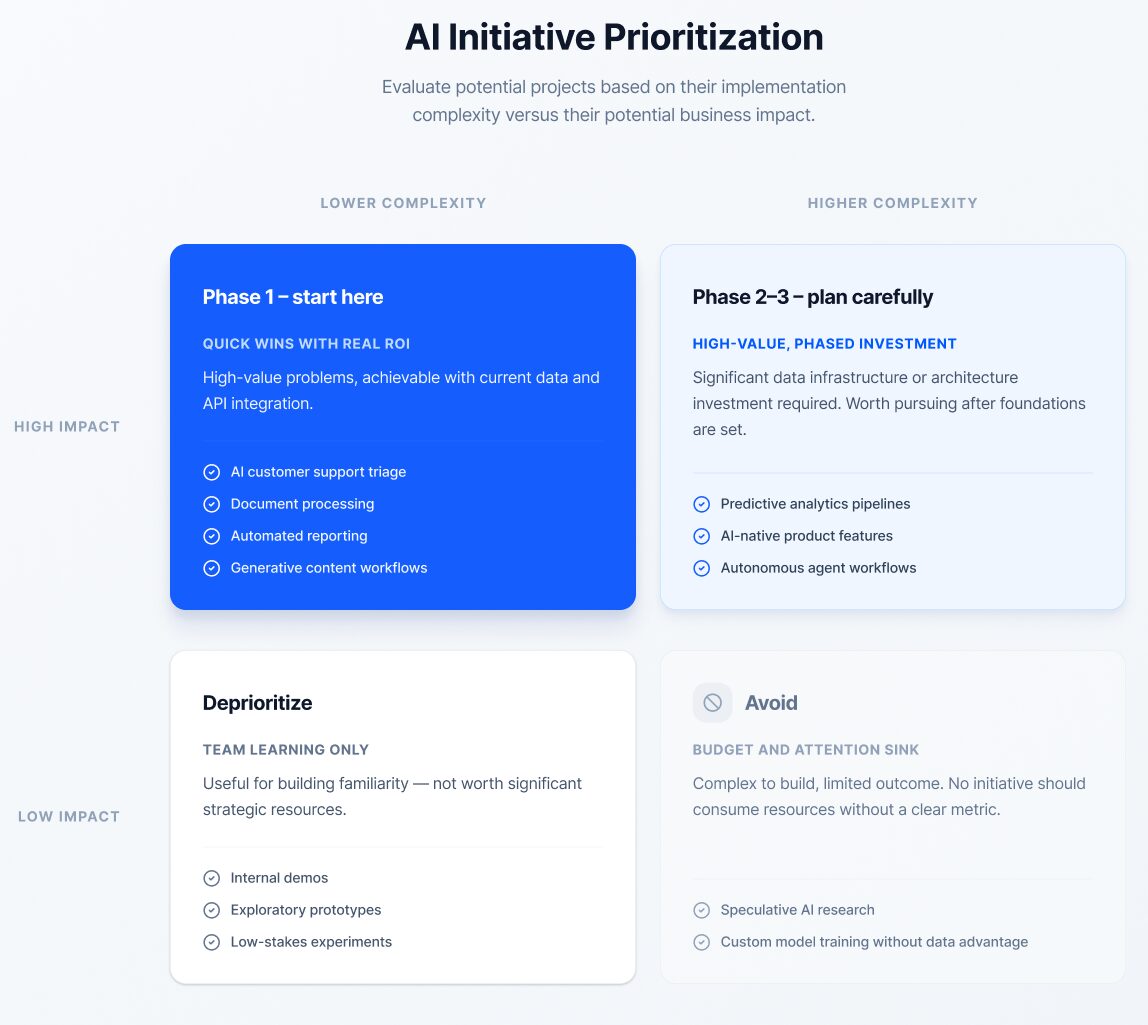
One pattern worth noting: the most impactful AI programs are not built around a single breakthrough use case. They are built around a portfolio of compounding capabilities, each one generating data, organizational learning, and technical infrastructure that makes the next one faster and more reliable.
The frontier is moving. Your strategy must move with it.
One critical quality of a durable AI strategy is adaptability. The landscape is shifting faster than most planning cycles anticipate. Base model capabilities improve quarterly. New architectural patterns like agentic systems, multi-modal interfaces and autonomous workflows are moving from research to production deployment faster than any prior wave of enterprise software.
Leaders who treat AI strategy as a one-time planning exercise will consistently lag behind those who build adaptive systems: roadmaps that evolve as models improve, governance frameworks that scale with deployment, and teams that continuously update their understanding of what is possible.
The Third golden age of software engineering: Field notes from AI Dev SF 26, written by our leadership after attending one of the leading AI development conferences, captures what the current frontier looks like from the inside. The shift from AI as a feature to AI as infrastructure.
The maturation of LLM orchestration patterns. The emergence of truly agentic systems operating in production. For any leader making investment decisions about AI in 2025 or 2026, it is essential reading.
What makes a strong Artificial Intelligence partner?
For most organizations, executing an AI strategy requires more than internal resources alone. The right technology partner brings not just engineering capability — but strategic judgment about where AI creates value, how to avoid the failure modes that consume budget without delivering outcomes, and how to build systems that hold up at scale.
When evaluating a partner, look for demonstrated capability across the full AI development stack: data infrastructure, model integration, application engineering, product design, governance, and the organizational experience to sequence these investments correctly. The ability to move from strategy to working production software, not prototypes, is the standard that matters.
Equally important is a partner that challenges you to start with problems. The best AI engagements begin with rigorous problem definition. The right partner will push back on the impulse to jump to a tool.
At Cheesecake Labs, our AI & Data practice combines deep expertise in machine learning, generative AI, LLM integration, agentic systems, and AI-powered product development. We work with enterprise teams to design and build AI capabilities that are production-ready, scalable, and aligned with real business outcomes.
Whether you are defining your AI strategy, building your first AI-powered product, integrating generative AI into an existing platform, or modernizing a legacy system with intelligent automation, our team has the depth to move fast without building fragile systems.
Ready to move from AI strategy to AI execution?
Most AI initiatives do not fail because the technology is too complex. They fail because the strategy was never precise enough to begin with, and because execution started before the foundations were in place.
At Cheesecake Labs, we help companies define the right problems, design the right systems, and build AI products that work in production. From AI strategy consulting to full product development and long-term team augmentation, our team brings the discipline and depth to move fast without building fragile systems. Talk to our team about your AI initiative!