
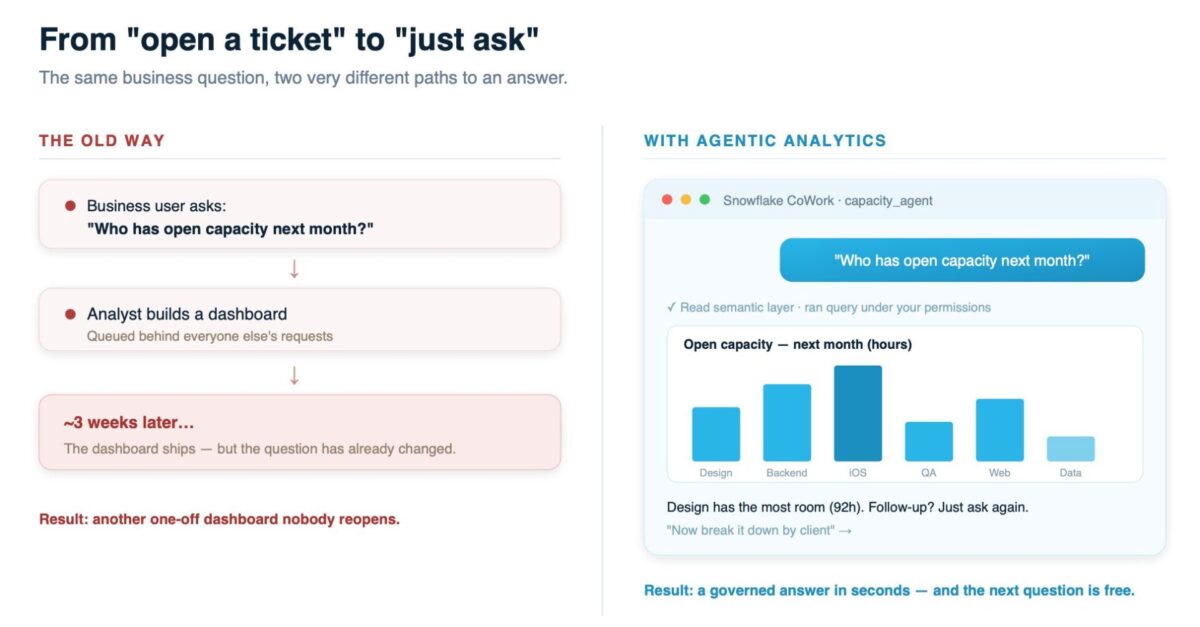
For twenty years, the answer to “can I get a view of X?” has been the same: someone opens a ticket, a data team builds a dashboard, and three weeks later the business question has changed. That model is ending.
Every major data platform now ships a conversational, agent-driven layer on top of the warehouse — Snowflake CoWork, Databricks Genie One, Microsoft Fabric Data Agents — and the architecture behind all three is converging on the same three parts.
We build these systems for a living. This post covers what we’ve learned shipping them to production — mostly on Snowflake, where the tooling matured fastest, but the architecture translates across all three platforms.
What is agentic analytics, and how does it work?
The pattern has three parts, whatever the vendor calls them:
The semantic layer defines what’s true
A governed definition of your business — entities, metrics, joins, and rules like “hours are computed per weekday only” or “actuals only count approved records.” This layer is where correctness lives. Worth noting that the three platforms implement it quite differently: a Snowflake semantic view is a declarative object you author.
Databricks’ Genie Ontology is a self-improving knowledge graph that auto-extracts meaning from tables, queries, dashboards, and connected apps; and Fabric semantic models inherit the Power BI modeling lineage. Same job, three philosophies — authored, learned, and BI-native.
Agents inherit the user’s permissions
Purpose-built Artificial Intelligence workers pointed at that semantic layer, each with a scoped goal: a churn agent on the sales data, a capacity agent on resourcing data. They translate natural language into SQL, run it, chart the results, and, critically, run under the user’s own credentials.
In Snowflake’s words, “all role-based access control and data-masking policies associated with the user automatically apply.” If you can’t see a table, neither can your agent. No new security surface.
The chat interface replaces the ticket
A dedicated workspace — Snowflake CoWork is now GA with a companion iOS app (Face ID, voice input, role and warehouse selection) — where a business user selects an agent and simply asks. Roles keep them scoped: they can query, but they can’t touch a warehouse or a pipeline by accident.
Read more: When to Move Your Data Out of Spreadsheets?
Where does agentic analytics pay off first?
The highest-ROI use cases we see share one trait: recurring questions with changing parameters, exactly what dashboards handle worst.
Which accounts are churning, and what do they share?
“Which accounts dropped usage more than 20% this quarter, and what did they have in common?” A churn agent over the sales semantic layer answers in seconds — and the follow-up question (“break that down by plan”), which would normally mean another ticket, is just the next message.
Who has open capacity in the next two weeks?
Time tracking, hours-bank balances, utilization, capacity planning. “Who has open capacity in the next two weeks?” “Is anyone trending toward overtime this month?” Ops managers ask these weekly; the parameters change every time. This is one of the domains where we’ve deployed agents in production, and the ticket-queue effect disappeared almost immediately.
Why is this line item up 14% this month?
Month-end close is a burst of one-off questions — variance explanations, anomaly hunts, “why is this line up 14%?” — that traditionally lands on an analyst’s desk all at once. An agent absorbs the burst.
What executives ask when they never open the dashboard
Leaders rarely open dashboards; they ask people. Giving them an agent (especially on mobile) meets that behavior instead of fighting it.
The common thread: you’re not replacing reports, you’re absorbing the long tail of questions that never justified building one.
Read more: Your AI Strategy Has a Data Problem
What surprised us running agentic analytics in production?
A few findings that don’t show up in the marketing pages:
Setup takes four SQL statements. The semantic layer takes months
Enabling CoWork and deploying a working agent takes four SQL statements. Snowflake’s own coding agent, CoCo (formerly Cortex Code), can even write the agent specification for you, because it reads the semantic view and understands the data model.
The real engineering effort, and where experience matters, is the semantic layer itself. If your business rules aren’t mapped and described there, no model will save you. This is the new data modeling, and it’s a skill, not a checkbox.
Agents catch their own mistakes
In one deployment, an agent noticed the totals it computed were implausibly high for a single person, traced the anomaly to duplicate rows in a directory join, corrected the query, and explained the correction before presenting results. That self-verification loop is the difference between a text-to-SQL demo and something you can put in front of a stakeholder.
Adoption follows trust, and trust follows scoping
Broad “ask anything about the company” agents underperform: they hedge, they miss business rules, and users stop trusting them after one wrong answer. Narrow agents with explicit instructions (“use approved records; prefer weekly aggregates; always chart”) are consistently right, and adoption compounds from there.
Cost is usage-based, and worth understanding before you commit
Since April 2026, Snowflake bills AI in flat-priced AI Credits — $2.00 each (global routing; $2.20 regional) — decoupled from your Snowflake edition. But an AI Credit is not a million tokens: consumption is metered per million tokens, input and output billed separately, and the credits-per-million rate depends on the orchestration model you pick.
A capable model can run several credits per million input tokens and multiples of that on output, so real cost per million tokens lands well above $2 — check the Service Consumption Table for your model. Add ordinary warehouse compute (attributable per agent) on top. The headline that still holds: there’s no per-seat licensing, and a scoped pilot is genuinely cheap — but “roughly $2” is the credit price, not your token bill.
It fills a real gap
Snowflake has no native analytics layer for non-technical users. If your stack is Snowflake without a BI tool on top, or with one that only the analysts open, this is the shortest path to genuine self-service. Business users don’t even need to see the Snowflake console: CoWork is its own link, scoped by role.
Read more: Spec-Driven Development: How to Capture Intent Before You Burn Tokens
Does agentic analytics replace your BI tool?
Not yet, and the honest answer has more nuance than “no.”
CoWork does produce visuals, and they persist: every chart or table it generates becomes a saved Artifact you can pin, share, and revisit without re-asking. It supports most Vega-Lite chart types like bar, line, heatmaps, box plots, dual-axis, small multiples — so the output is real, not a throwaway image in a chat log. If your definition of “dashboard” is “a chart I can come back to,” CoWork already clears that bar.
What it is not is a governed BI product. It doesn’t give you a curated single-pane board of a dozen KPIs laid out just so, on a scheduled refresh, distributed by email or embedded for people who never log into Snowflake, with alerting and pixel-perfect formatting. That’s still Power BI / Tableau / Snowsight dashboard territory: curated, recurring monitoring with wide distribution and predictable cost.
So the division of labor is: monitoring stays on glass; exploration moves to conversation. What agentic analytics eliminates is the dashboard built to answer one question, once, that nobody maintains afterward.
Teams that frame it this way get adoption; teams that announce “we’re replacing Power BI” get a turf war. One caveat worth flagging to any client: this frontier is moving fast — the CoWork rebrand added workflow automation and multi-agent orchestration — so the “can’t build dashboards” line is likely to soften over the next few releases. Bet on the division of labor, not on the current feature gap.
How do Snowflake CoWork, Databricks Genie One, and Fabric Data Agents compare?
Here’s the part that matters if you’re choosing (or already chose) a platform: the architecture is converging, so the skills transfer.
- Snowflake CoWork: agents defined in SQL/YAML over semantic views, MCP connectors for external context, custom skills, per-agent warehouse attribution.
- Databricks Genie One: an “agentic coworker” over Genie Spaces and metric views, powered by the Genie Ontology knowledge graph.
- Microsoft Fabric Data Agents: configurable conversational agents over OneLake and semantic models, publishable directly into M365 Copilot so users ask questions inside Teams.
The vendor layer differs; the discipline doesn’t. In every case the outcome depends on the same things: a well-modeled semantic layer, tightly scoped agents, permissions done right, and an honest division of labor with your existing BI. That’s precisely the kind of work that’s platform-independent — and precisely where most teams get stuck.
How do you roll out agentic analytics without losing the room?
The playbook we use, condensed:
- Pick one domain, not “the company”: Choose where the same flavor of question arrives weekly and the answer is currently a ticket.
- Invest in the semantic layer first: Map the entities, metrics, and, most importantly, the business rules and exceptions. This is 80% of the effort and 100% of the quality.
- Write agents like job descriptions: Explicit scope, explicit rules, explicit output preferences. Vague agents give vague answers.
- Get access design right on day one: Agents inherit user permissions — decide which roles see which agents (they live in schemas, so schema access is the lever) and give business users the chat link, not the console.
- Measure ticket deflection, not chat volume: The success metric is questions that stopped arriving at the data team. Then expand domain by domain.
The platforms have made the technology trivial. The judgment — what to model, how to scope, where conversation beats dashboards — is where the leverage is.
Ready to make your data answerable? If your data team is still absorbing the same questions every week, we’ll map your semantic layer and scope the first agent. Book a call and we’ll tell you exactly what we’d build, and what we wouldn’t.