
The slide deck looked confident. Twelve pages. A clear value creation thesis. AI-driven operational improvements projected to expand EBITDA by three percentage points within the first 18 months. The investment committee approved it. The deal closed.
Three weeks later, the Operating Partner sat across from the portfolio company’s VP of Technology and asked a simple question: “Where does your customer data live?”
The answer took eleven minutes. There was a CRM. There was also a separate order management system. There was a data warehouse that had been partially built two years ago and then deprioritized when the lead engineer left. There were spreadsheets — more than anyone had counted. The ERP was from 2011. The API layer that was supposed to connect everything had never been finished.
The EBITDA model had assumed that data was accessible, clean, and queryable. It was not. And until it was, nothing in the AI strategy could move.
This is not an unusual story. It is, in fact, the most common technology story in mid-market private equity. And it is exactly why the AI strategy conversation is the wrong conversation to have first.
Strategy without diagnosis is guesswork
Private equity firms are extraordinarily disciplined about financial due diligence. Legal, accounting, market analysis, customer concentration, supplier risk — all of it is stress-tested before the deal closes. The financial model is built on verified inputs.
Technology due diligence rarely gets the same treatment. And AI readiness almost never does.
The result is that the value creation plan arrives at the portfolio company carrying assumptions about infrastructure, data quality, and engineering capability that have never been validated. The plan says “implement AI-driven demand forecasting.” The reality is that the demand data lives in three systems and the team has never built a data pipeline.
“An AI strategy built on unexamined infrastructure assumptions is not a strategy. It is a projection.”
The 58% of PE-backed companies that arrive at acquisition with no formal AI strategy are not the problem. Companies with no strategy can build one. The more expensive problem is the company with an ambitious AI strategy and a technology reality that cannot support it — because now the mismatch has been built into the value creation timeline, the board reporting, and the Operating Partner’s 100-day commitments.
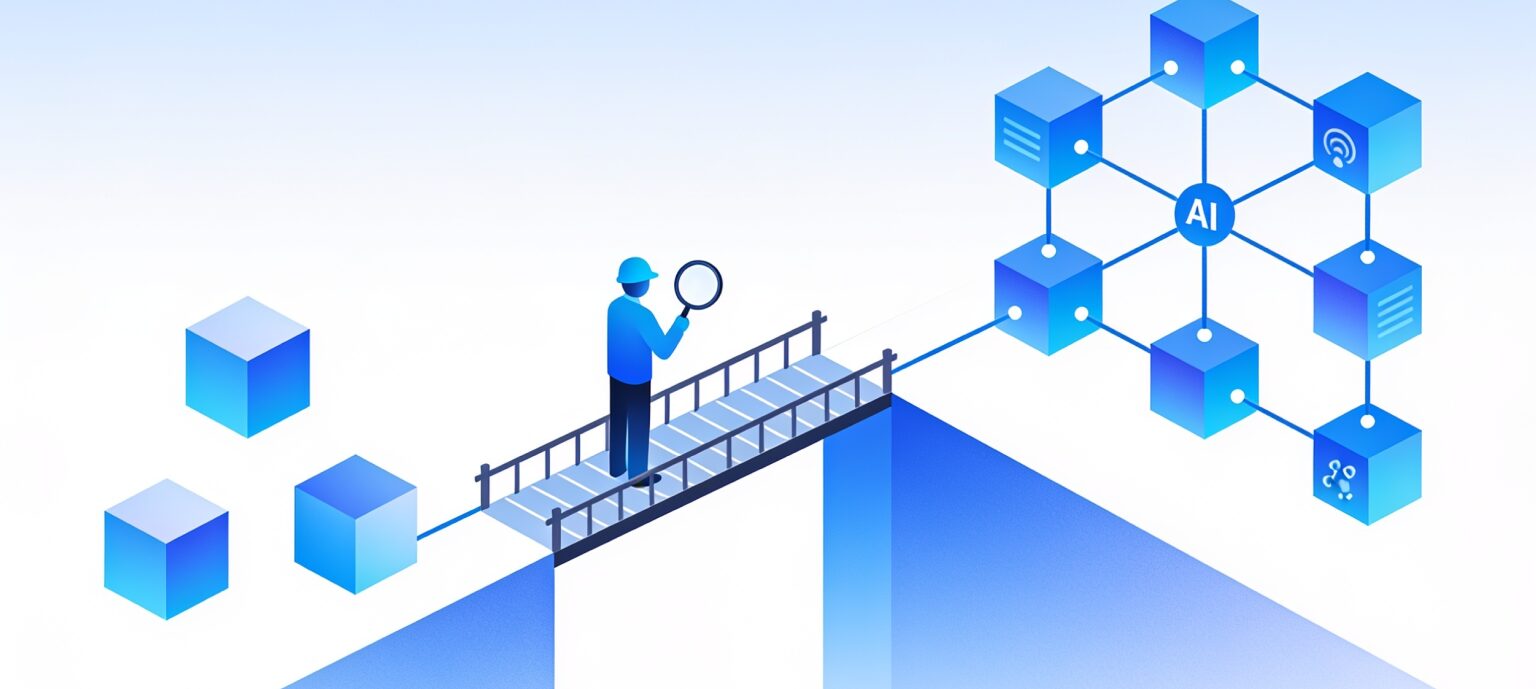
The diagnostic has to come first. Not because strategy is unimportant, but because the strategy cannot be accurate until someone has honestly assessed what exists underneath it.
What the 100-day window actually requires
The 100-day plan is the most consequential document in a PE-backed company’s early life. It sets the operating cadence, aligns the team around priorities, establishes what gets measured, and creates the baseline against which future board reporting is compared.
When the technology component of the 100-day plan is built on assumptions rather than diagnosis, three things happen:
- Timelines slip. Work that was scoped for 90 days takes 240 because the foundational infrastructure wasn’t accounted for.
- Budgets expand. Data migration, system integration, and legacy modernization costs appear mid-project and require board approval that wasn’t anticipated.
- Momentum stalls. The AI initiative that was the centerpiece of the value creation story becomes the thing nobody mentions in the quarterly update.
None of this is inevitable. But it is predictable when the 100-day plan skips the diagnostic step.
The alternative is to treat the first 30 days of the hold period as the diagnostic phase — the period in which technology reality is mapped, not assumed. What comes out of that diagnostic is not a delay to the strategy. It is the foundation that makes the strategy executable.
WHAT THE FIRST 100 DAYS OF A PE HOLD PERIOD ACTUALLY DEMANDS FROM A TECHNOLOGY STANDPOINT: An honest, structured assessment of where the company is — not where the model assumed it would be. Data quality, technology infrastructure, workflow complexity, engineering capability, and organizational readiness. Five dimensions. One clear output: a sequenced modernization roadmap that the delivery team can execute and the board can measure.
The five dimensions that determine AI readiness
After 12 years of building technology in regulated, data-heavy industries (financial services, payments, energy, industrial operations), we have found that AI readiness comes down to five dimensions. A company can be strong in three and completely stalled by the fourth. They all have to be assessed together.
| 1 – Data quality and accessibility | Is the data clean, centralized, and queryable? Not theoretically, actually. Can a data scientist sit down and build a training set without first spending six weeks cleaning and centralizing exports? In most mid-market companies acquired by PE, the answer is no. This is where most AI initiatives die before they start. |
| 2 – Technology infrastructure | Can the existing architecture support what is being asked of it? Are there APIs that allow systems to communicate? Is the data warehouse designed for AI workloads? Is the cloud infrastructure modern enough to run what the strategy requires? Legacy infrastructure does not prevent AI, but it has to be inventoried and factored into the roadmap. |
| 3 – Workflow complexity and manual intensity | Where is the work actually happening? Not at the system level — at the human level. Which processes are running on manual judgment, email threads, and spreadsheets? These are both the biggest AI opportunities and the biggest implementation risks. They require mapping before they can be automated. |
| 4 – Financial performance attribution | Can the business connect operational processes to financial outcomes at the process level? If you improve the demand forecasting workflow, can you measure the inventory cost reduction? If you automate the customer onboarding process, can you measure the revenue acceleration? Without this connection, AI ROI cannot be demonstrated to the board. |
| 5 – Organizational readiness | Does the team have the engineering capability to build and maintain what the strategy requires? Is there an internal champion who understands both the business problem and the technical solution? Is there cultural alignment between the PE operating thesis and the company’s actual appetite for change? A technically perfect plan deployed into an organizationally resistant company will stall every time. |
These five dimensions are not a checklist. They interact with each other. Weak data quality caps the value of strong infrastructure. High workflow complexity without financial attribution produces AI implementations that cannot justify their own cost. Organizational resistance overrides all of it.
The AI Readiness Assessment maps all five in a structured 2 to 4 week engagement, producing a clear picture of where the company is, what needs to happen before AI initiatives can succeed, and in what sequence the work should proceed.

Why this is a PE-specific problem
Every company faces these infrastructure challenges eventually. But PE-backed companies face them under a set of conditions that make the diagnostic more urgent and the consequences of skipping it more severe.
| PE-specific pressure | Why it changes the calculus |
| Compressed hold period | A typical 3 to 5 year hold period means there is no time to discover infrastructure gaps at month 18. The diagnosis has to happen in the first 30 days, not the first 18 months. |
| Board-level AI mandate | AI is not a nice-to-have in most PE value creation plans. It is a thesis. When the mandate is board-level, the consequences of stalled implementation are board-level too. |
| Exit valuation dependency | PE funds that deploy AI correctly see 0.5x to 1.5x of multiple lift at exit. That lift requires demonstrated AI-driven EBITDA improvement — which requires implementation that actually runs in production, not pilots that never shipped. |
| Operating Partner bandwidth | Most Operating Partners are managing technology initiatives across 8 to 15 portfolio companies simultaneously. A structured diagnostic that produces a clear, executable roadmap is a force multiplier — it removes the ambiguity that consumes operating bandwidth. |
| Post-acquisition transition risk | The 100-day period is when systems, teams, and operating models are in flux. Technology partners selected during this window become embedded in the company’s operating infrastructure. Incumbents are difficult to displace after the transition is complete. |
The compressed timeline is what makes the 100-day diagnostic window so critical. In a non-PE-backed company, discovering that the data architecture needs to be rebuilt at month 18 is frustrating but recoverable. In a PE-backed company with a 36-month value creation plan, it is a structural problem that directly threatens the exit thesis.
Read more: Private Equity is Committed to AI: Most Portfolio Companies Aren’t Ready
What a repeatable portfolio diagnostic looks like
For Operating Partners managing technology across multiple portfolio companies, the AI Readiness Assessment is most valuable when it is not a one-off engagement but a repeatable portfolio-wide instrument.
The five-dimension framework is the same for every company. What changes are the specific findings and the sequenced roadmap that comes out of them. This allows an Operating Partner to:
- Establish a consistent technology baseline across all portfolio companies within the first 90 days of acquisition.
- Compare readiness levels across the portfolio and prioritize technology investment accordingly.
- Bring a consistent language and framework to board reporting on technology value creation.
- Identify the implementation partner who can execute the roadmap — once, not repeatedly for each company.
The firms doing this best in 2026 are not treating AI as a portfolio-company-level initiative. They are treating it as a firm-level operating model — with a standard diagnostic, a standard roadmap methodology, and a small set of implementation partners who understand their investment thesis and can execute consistently across companies.
“One relationship with a mid-market Operating Partner is not one engagement. It is a framework that scales across every company they manage.”
What to do in the next 30 days
If you are an Operating Partner who has acquired a company in the last 12 to 24 months and the technology component of the value creation plan is still running on assumptions rather than diagnosis — the window is not closed, but it is narrowing.
If you are a CTO or VP of Technology at a PE-backed company with a board mandate to “implement AI” and an infrastructure reality that does not yet match that mandate — the diagnostic is the right first step, not a delay.
The AI Readiness Assessment is a 2 to 4 week structured engagement that produces five things:
- A clear map of your data quality and accessibility across all systems.
- An inventory and assessment of your current technology infrastructure against AI workload requirements.
- A workflow map of the processes with the highest AI ROI potential.
- A financial attribution model connecting operational process improvements to EBITDA impact.
- A sequenced modernization roadmap with time, budget, and priority, ready for board presentation.
The output is not a strategy document. It is an execution plan built on what is actually true about your business, not what the model assumed.