Building Smarter White-Label Apps with Modular SDKs
Leandro Pontes Berleze | Mar 12, 2026
Cryptocurrencies have come a long way from their early experimental days. What started as a push toward decentralized finance and borderless transactions has now evolved into a complex ecosystem of different assets, platforms, and protocols. A lot has changed. But one thing has remained — volatility.
For everyday users and businesses, price swings in assets like Bitcoin and Ethereum make it challenging to rely on crypto for real-world transactions or savings. That’s where stablecoins come in. They combine the innovation of blockchain technology with the dependability of traditional money, creating a bridge between the two worlds.
In this post, we’re looking at what stablecoins are, how they work, and why they’re playing a central role in making blockchain-based money practical, accessible, and ready for real-world use.
Stablecoins are digital assets designed to maintain a stable price by being tied (or “pegged”) to a stable asset (or a fraction thereof), such as a fiat currency, a commodity, or a basket of assets.
This peg is supported by different mechanisms (such as reserve backing, collateralized lending, or algorithmic supply adjustments) that help keep the stablecoin’s price close to its target value.
Stablecoins combine the transparency and efficiency of blockchain with the reliability of traditional financial systems. They enable fast, low-cost transactions and act as a practical entry point for both individuals and organizations exploring digital currencies.
While the goal of all stablecoins is the same (price stability), the mechanisms they use to achieve it vary. Here are the four main models currently shaping the market.
Fiat-backed stablecoins are backed by a real-world currency. These stablecoins make up the largest share of the market and are widely used for payments, transfers, and savings.
A well-known example is USDC, which aims to maintain a 1:1 peg to the US dollar.
Commodity-backed stablecoins use assets like gold to maintain value. A good example is PAX Gold, where each token represents one fine troy ounce of gold stored in a vault. They use contracts to guarantee value.
These stablecoins rely on other cryptocurrencies as collateral. DAI is the leading example. DAI is a decentralized stablecoin on the Ethereum network that aims to maintain a value of $1.00 USD. Rather than being pegged to the US dollar, DAI uses overcollateralization and smart contracts to hold its peg to the dollar.
Crypto-backed stablecoins are more decentralized, but can be affected by market volatility.
Algorithmic stablecoins maintain their value through complex market analysis. They use supply-and-demand mechanics to adjust token supply and maintain stable prices. This is the most experimental type of stablecoin and carries a higher risk, which has been illustrated by past depegging events.
Stablecoins solve several pain points in both traditional finance and the crypto space. Their value isn’t just about price stability — it’s also about accessibility, speed, and practical utility.
Here are just a few reasons why stablecoins are an important part of the modern digital finance landscape.
Many people use stablecoins without even thinking of them as “crypto.” They often feel like digital dollars rather than a new type of currency.
This gives newcomers to the crypto space a low-risk entry point to start learning about blockchain-based payments and digital wallets. Their stable, predictable value removes the fear of volatility while still letting people take advantage of quick on-chain transactions.
The whole point of stablecoins is right there in the name — they’re stable and steady. Whether you’re saving money, making payments, or receiving remittances from abroad, stablecoins offer a sense of financial predictability that isn’t found in many crypto assets.
If you’ve ever been caught waiting for a wire transfer over the weekend or on a public holiday, you already know that traditional financial transfers come with business hours, cut-off times, and layers of intermediaries.
Stablecoin transfers usually settle within seconds, at any time of day. This makes them especially valuable for:
In many countries, stablecoins are already used to pay bills, receive salaries, send money to family members, protect savings from inflation, and more.
Wallet providers are expanding their offerings to support these everyday use cases, creating tools that make paying, receiving, and storing money in stablecoins easy and intuitive. This is particularly true in Latin America, where digital wallets built on networks like Stellar are helping millions access fast, reliable financial services.
| For a closer look at the networks making this possible, read our posts about Stellar anchors and USDC on the Stellar Network. These posts explore how Stellar’s blockchain infrastructure enables real-world payments, remittances, and savings with stablecoins. |
Cheesecake Labs Celebrates Five Years as Go-To Stellar Integration Partner
Stablecoins give people access to digital finance even without a traditional bank account. A simple wallet app can open the door to global payments and stable-value storage. This has significant implications for humanitarian aid, remittances, and international payroll.
While stablecoins offer stability and convenience, they are not without their risks. Understanding these challenges is key for anyone using, investing in, or building with stablecoins.
Many of these risks arise from the mechanisms that maintain the peg, the entities issuing the coins, and the evolving regulatory environment.
Here are some of the main risks and challenges associated with stablecoins:
Stablecoins rely on robust mechanisms to keep their value tied to an underlying asset. Whether backed by cash reserves, crypto collateral, or algorithmic rules, these systems need to be carefully managed to prevent the coin from losing its peg.
Failures in these mechanisms — due to poor design, sudden market swings, or mismanagement — can quickly destabilize the coin and erode user trust.
Although blockchain is often associated with decentralization, many popular stablecoins are issued and controlled by private companies (like the issuers of Tether/USDT).
This centralization can create risk because the issuing entity has influence over supply, reserve management, and governance decisions.
Users must be able to trust that the issuer will act responsibly — a challenge that can clash with blockchain’s original philosophy of decentralization.
Even if a stablecoin is backed or algorithmically maintained, market confidence is critical. Historical examples like TerraUSD (UST) demonstrate that once trust is lost, a stablecoin can rapidly lose value. In TerraUSD’s case, a partial peg to other volatile cryptos led to a collapse, severely eroding user confidence.
Maintaining credibility and transparency is just as important as the technical backing.
A key part of trust is verifiable proof that reserves exist and are sufficient to back the coin. Auditing can be complicated and resource-intensive, requiring regular updates, third-party verification, and clear reporting.
Controversies over Tether and other coins show how challenging this process can be in practice.
Governments and regulators are increasingly involved in the stablecoin space. Laws like the Clarity for Payment Stablecoins Act of 2023 aim to create frameworks for safety and oversight.
While some in the crypto community view regulation as interference, many institutions appreciate the confidence it brings, making stablecoins more viable for mainstream adoption.
Stablecoins are not just a theoretical tool for crypto enthusiasts — they serve practical, everyday purposes for individuals, businesses, and even governments. Their unique combination of stability and blockchain efficiency makes them useful across a range of financial activities.
Let’s explore some of the key ways people and organizations are using stablecoins.
One of the primary advantages of stablecoins is convenience for cryptocurrency investors. Unlike more volatile assets, stablecoins allow investors to “park” their money while buying or selling other cryptocurrencies. This means funds can stay on-chain without needing to cash out to a traditional bank account, reducing friction and making it easier to respond quickly to market opportunities.
Stablecoins act as a stable digital holding place, providing both liquidity and flexibility for active traders.
Stablecoins are increasingly used for cross-border payments, especially for remittances to less developed countries.
Traditional international transfers often come with high fees, prolonged processing times, and limited access for unbanked populations. Stablecoins bypass these barriers: anyone with a smartphone can send and receive payments almost instantly, without needing a traditional bank account.
This opens up faster and more affordable global transactions for people who previously had limited financial access.
In countries experiencing hyperinflation, like Argentina and Venezuela, stablecoins are being used as a practical hedge against currency devaluation.
Citizens often can’t easily obtain foreign currency through formal financial services, making stablecoins pegged to reliable assets like the US dollar an attractive alternative.
By converting local funds into stablecoins, people can protect their savings and maintain purchasing power in environments where local currencies lose value rapidly.
AI Use Cases & Applications: How Businesses Are Leveraging AI
Real-world implementations of stablecoins show how this technology moves beyond theory and into everyday financial life. Here at Cheesecake Labs, we’ve been involved in multiple projects that illustrate the practical benefits and innovative applications of stablecoins.
Here are just a couple of examples of our work with stablecoins:
Vesseo (formerly Vibrant) is a wallet developed by the Stellar Development Foundation (SDF) in partnership with Cheesecake Labs. It has evolved into a versatile financial tool with real impact across Latin America.
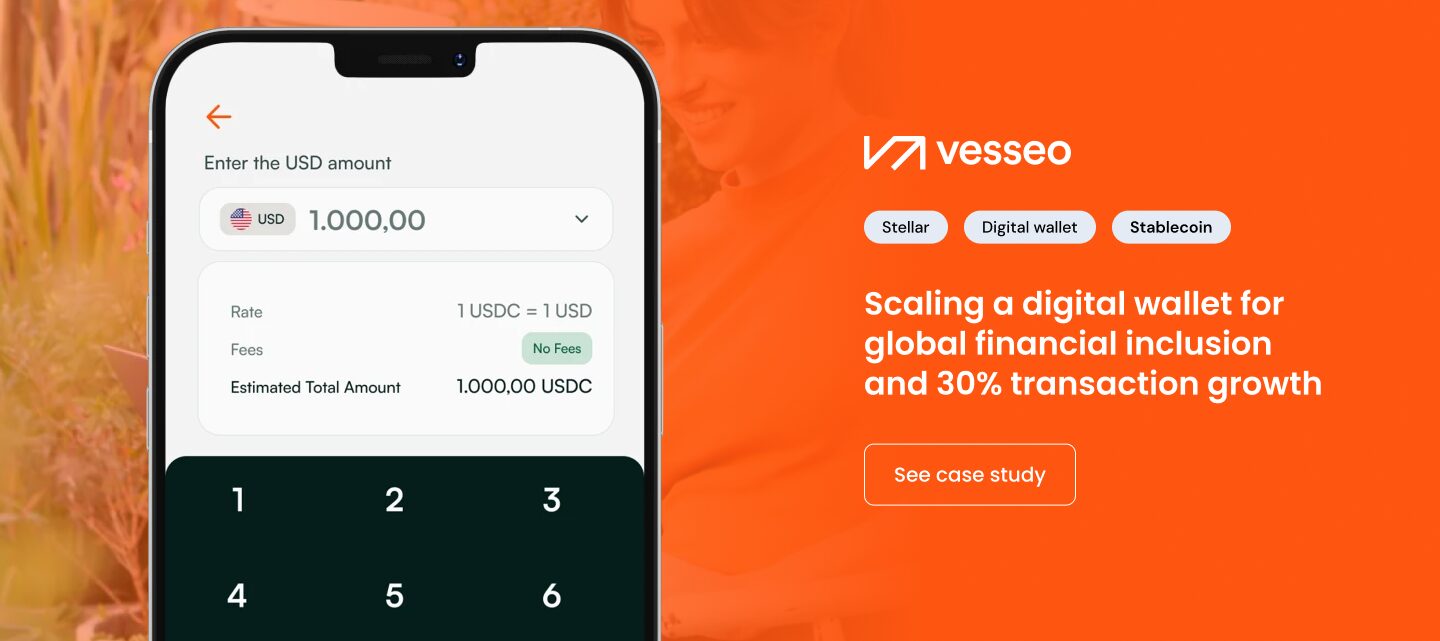
This project highlights How blockchain-based wallets can address both financial inclusion and everyday convenience.
MoneyGram partnered with Cheesecake Labs and Stellar to explore a stablecoin-enabled, non-custodial wallet designed for fast, secure, and accessible cross-border payments.

Learn more about our work on MoneyGram’s non-custodial wallet.
This project was showcased at Meridian 2023 and demonstrates how established financial brands are incorporating stablecoins into mainstream operations, bridging the gap between traditional finance and digital assets, and expanding access to people with limited banking options.
While classic wallets allow users to store and transfer stablecoins, the next evolution in digital finance is smart wallets, also called programmable wallets. These wallets leverage smart contracts to automate actions, enforce rules, and integrate with decentralized financial systems, offering far more flexibility and control than traditional wallets.
Smart wallets are not just accounts — they’re programmable contracts that execute pre-defined instructions automatically. Key features include:
Here are just a few of the potential applications for smart wallets:
Programmable wallets have the potential to move stablecoins beyond simple storage and transfer. They allow users and businesses to embed intelligence, automation, and complex financial logic directly into their funds.
This opens new possibilities for payroll, cross-border payments, financial inclusion, and integration with decentralized applications.
Stablecoins are reshaping how money moves, combining the reliability of traditional currencies with the speed, efficiency, and programmability of blockchain technology. From everyday payments to global remittances and smart wallet applications, they are opening up new possibilities for individuals, businesses, and financial institutions alike.
For more information, check out our presentation on stablecoins at Blockchain Rio.
Or if you’re interested in exploring how stablecoins and smart wallets can benefit your business, Cheesecake Labs can help. Our team has extensive experience in blockchain development and can help you bring your ideas to life.
Get in touch with Cheesecake Labs today.