Product Framework: Model Fallback and AI Pricing Strategy for better decision-making
Bruna Gomes | Mar 25, 2026

Machine learning has become one of the most transformative technologies of the digital era. It sits at the core of artificial intelligence systems, enabling software to move beyond static rules and into adaptive, predictive, and increasingly autonomous behavior.
Search engines use it to rank results. Banks rely on it to detect fraud in milliseconds. Healthcare providers apply it to improve diagnostic precision. SaaS platforms embed it into AI copilots that assist users in real time.
For organizations building AI-powered products, machine learning is part of a foundational infrastructure.
Machine learning is a branch of artificial intelligence that enables computer systems to learn from data, recognize patterns, and make decisions or predictions without being explicitly programmed for every scenario.
Traditional software follows predefined instructions written by developers. Machine learning systems, in contrast, derive their own internal logic by analyzing examples. Instead of telling the system exactly how to solve a problem, developers provide data and an optimization objective. The system learns the mapping.
At its core, machine learning transforms data into decision-making capability. This shift from rule-based logic to data-driven learning is what makes modern AI systems adaptive, scalable, and continuously improving.
Machine learning systems operate through an iterative cycle of data ingestion, training, evaluation, and refinement. The underlying principle is statistical optimization.
A model begins as a mathematical structure with adjustable parameters. During training, it analyzes historical data and measures prediction errors. Using optimization algorithms, the model updates its internal parameters to minimize those errors.
The system gradually improves its performance by learning patterns embedded in the data.
Unlike static code, a machine learning model’s behavior is shaped by exposure to information. The more representative and high-quality the data, the more reliable the system becomes.
Read more: AI & Machine Learning Glossary: Key Terms for Modern Businesses
Machine learning systems are only as strong as the data they rely on. Organizations that treat data as a byproduct of operations struggle with AI initiatives. Those that treat data as strategic infrastructure build sustainable competitive advantages.
Data must be collected responsibly, structured consistently, and governed rigorously. Privacy, compliance, and ethical constraints are not secondary concerns; they are architectural requirements.
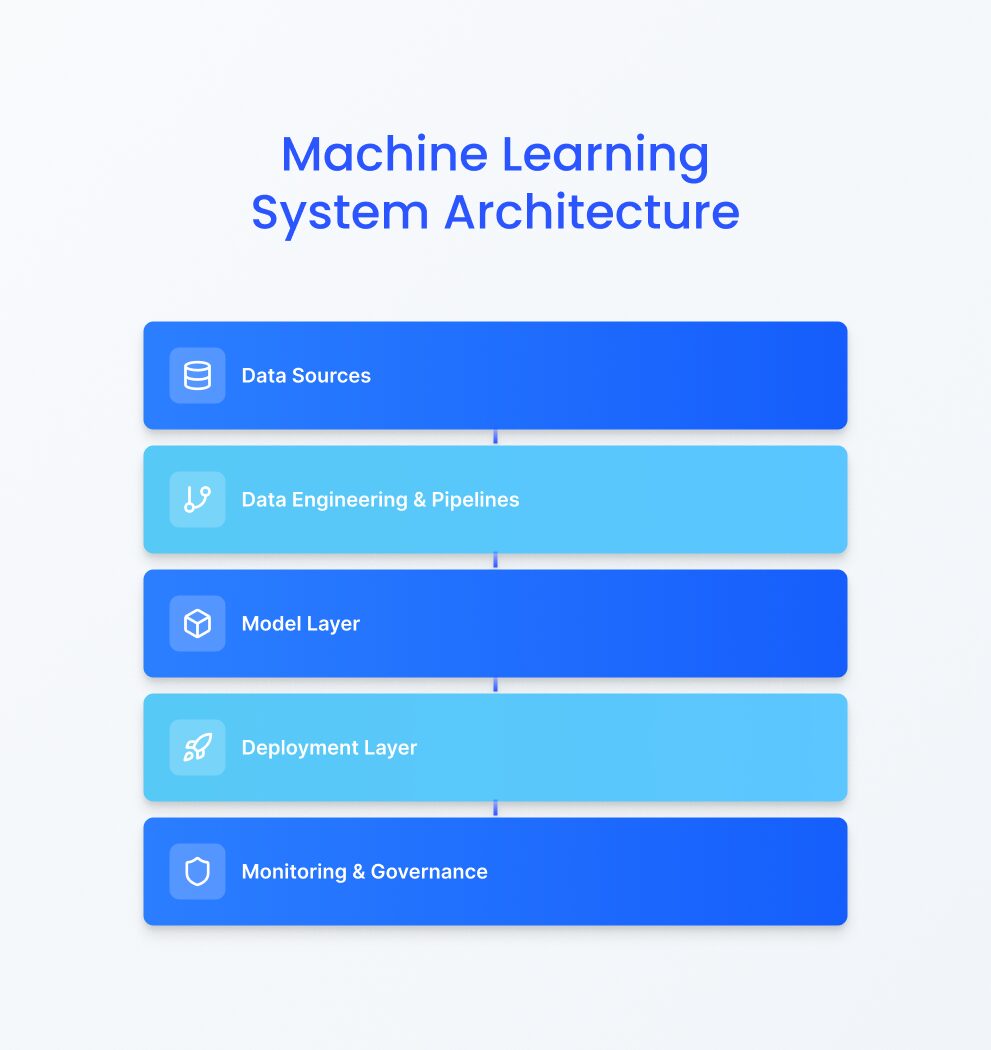
During training, algorithms identify relationships between inputs and outputs. These relationships are encoded in model parameters.
A central challenge is balancing complexity. Models that are too simple fail to capture meaningful patterns. Models that are too complex may memorize data rather than generalize from it. The goal is generalization — the ability to perform well on unseen data.
This tension between underfitting and overfitting defines much of practical machine learning engineering.
Testing a model on unseen data is essential. Performance metrics vary depending on the problem: classification, regression, ranking, or recommendation.
Beyond statistical metrics, modern machine learning systems must also address fairness, bias, interpretability, and robustness. Especially in healthcare, finance, and regulated industries, explainability is no longer optional.
At this level, we evaluate the model’s performance on test data. However, high accuracy in a controlled dataset does not guarantee real-world success.
This is the engineering lens. Operational reliability focuses on:
A model that works perfectly in a notebook may fail in production due to:
This is where MLOps becomes critical. Together, these define production-grade ML (Machine Learning).
Modern ML systems influence credit approval, medical decisions, hiring processes, and financial risk assessments. That introduces ethical and regulatory constraints.
Key concerns include:
A highly accurate model can still be dangerous if:
Many organizations optimize only for statistical performance. Enterprise AI requires optimization across all three dimensions simultaneously:
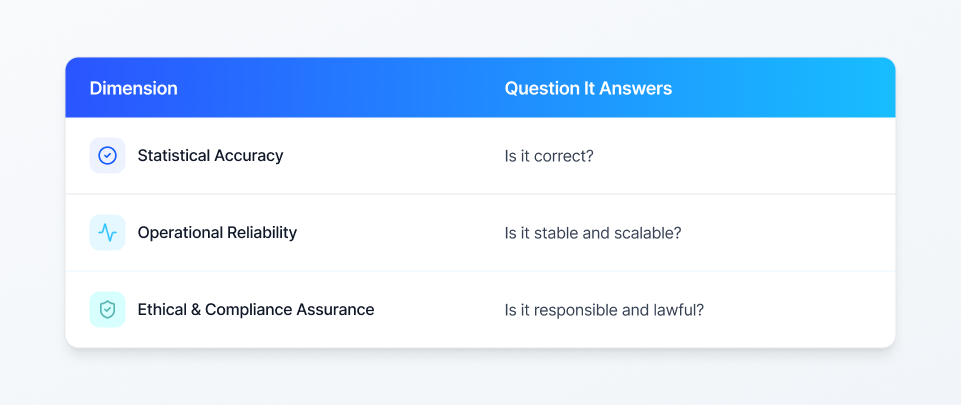
The intersection of these three creates production-grade, enterprise-ready Machine Learning.
Deploying a model into production transforms it from an experiment into infrastructure. At this stage, scalability, latency, and cost efficiency become critical.
Over time, real-world data distributions shift. This phenomenon, known as data drift or concept drift, can degrade performance. Continuous monitoring and retraining pipelines — often referred to as MLOps — ensure systems remain accurate and aligned with business objectives.
Machine learning systems are not static assets. They are evolving organisms within a digital ecosystem.
Read more: AI Use Cases & Applications: How Businesses Are Leveraging AI
Machine learning approaches vary with the problem structure and the availability of labeled data.
Supervised learning is the most common approach in enterprise systems. It relies on labeled datasets where historical outcomes are known. The model learns to predict future outcomes based on past examples. This technique underpins fraud detection, credit scoring, churn prediction, and revenue forecasting.
Unsupervised learning, by contrast, identifies hidden patterns without predefined labels. It reveals clusters, anomalies, and relationships that may not be obvious. This is particularly valuable in customer segmentation, behavioral analysis, and early-stage exploratory data science.
Semi-supervised learning blends both approaches, enabling systems to learn from limited labeled data combined with large unlabeled datasets. This reduces labeling costs while maintaining strong performance.
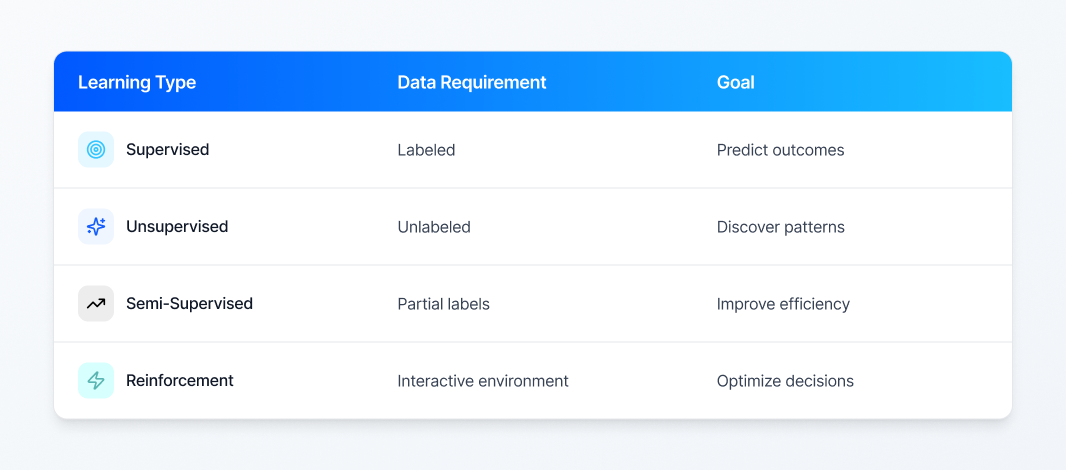
Reinforcement learning represents a different paradigm. Instead of learning from static datasets, the system interacts with an environment and learns through rewards and penalties. This approach is often applied in robotics, autonomous systems, and dynamic optimization problems.
Deep learning is a specialized subset of machine learning built on multi-layer neural networks. It excels at processing complex, high-dimensional data such as images, speech, and natural language.
While traditional machine learning often relies on engineered features, deep learning can automatically learn hierarchical representations directly from raw data.
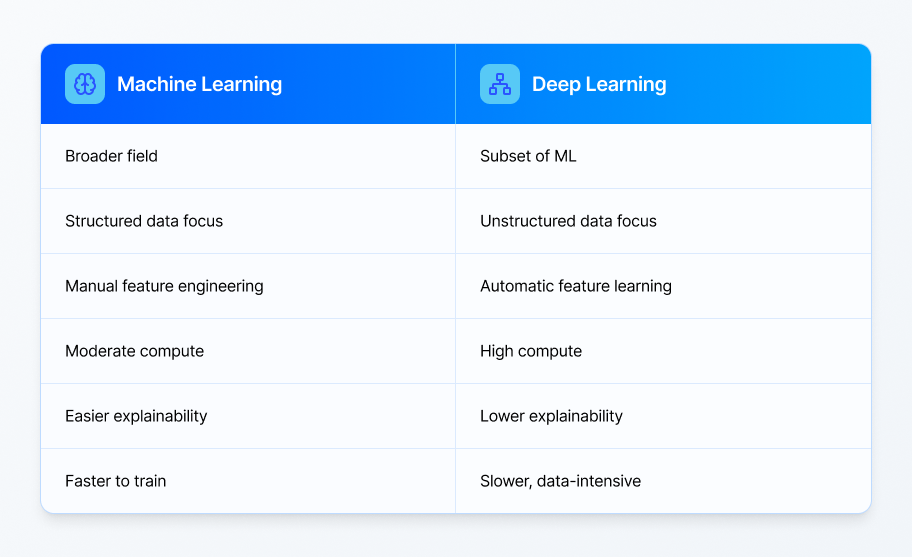
Large language models (LLMs), computer vision systems, and speech recognition engines are examples of deep learning applications.
The distinction matters because deep learning requires greater computational resources and larger datasets. However, it also enables capabilities that were previously unattainable.
Machine learning fundamentally shifts how organizations operate.
In finance, it enables real-time fraud detection and predictive risk modeling. For healthcare, it supports diagnostic imaging analysis and patient outcome forecasting. In retail, it powers recommendation systems and dynamic pricing engines. In SaaS platforms, it enhances user experiences through intelligent automation and AI copilots.
More importantly, machine learning changes the decision-making paradigm. Organizations transition from descriptive analytics to predictive and prescriptive intelligence.
Moreover, this shift reduces uncertainty, accelerates execution, and unlocks new revenue streams.
Descriptive → Diagnostic → Predictive → Prescriptive → Autonomous
Machine learning sits at the heart of this progression.
Case study: Knapsack Chat: Simple, Secure AI Integration for SaaS
As machine learning systems influence critical decisions, governance becomes essential.
Bias mitigation, model transparency, auditability, and privacy-first architecture are now regulatory and reputational imperatives.
Responsible AI frameworks require:
Enterprise-grade ML systems must integrate ethical safeguards directly into architecture.
Many organizations build impressive prototypes that fail to scale.
Production-grade machine learning systems require:
The difference between experimentation and infrastructure lies in operational maturity.
A system diagram board showing data pipelines flowing into model services, connected to monitoring dashboards and retraining loops, can make this architecture tangible for readers.
Machine learning is increasingly converging with generative AI, autonomous agents, and real-time analytics.
Future systems will not merely predict outcomes. They will generate content, reason through multi-step tasks, and autonomously execute workflows within defined constraints.
Moreover, the next generation of digital products will embed machine learning as a core capability, enabling continuous adaptation to user behavior and environmental change. Organizations that invest in scalable ML architecture today will define the intelligent systems of tomorrow.
Machine learning is not simply a technology, but a structural transformation in how software systems are designed and how organizations make decisions. It requires technical rigor, architectural discipline, data governance, and strategic alignment.
When implemented thoughtfully, machine learning becomes more than a predictive tool, but also the backbone of intelligent, adaptive, and scalable digital products.
At Cheesecake Labs, we help enterprises to design, build, and scale machine learning systems that are secure, compliant, and ready for real-world complexity. You can check our portfolio here!
If you’re ready to move beyond experimentation and build machine learning systems that drive measurable business impact, our team is ready to partner with you. Let’s build intelligent systems that scale!

The four main types of machine learning are supervised learning, unsupervised learning, semi-supervised learning, and reinforcement learning. Supervised learning uses labeled data to predict outcomes, unsupervised learning identifies hidden patterns in unlabeled data, semi-supervised learning combines both approaches, and reinforcement learning trains systems through rewards and penalties in interactive environments.
Artificial intelligence is the broader concept of building systems capable of performing tasks that typically require human intelligence. Machine learning is a subset of artificial intelligence that focuses specifically on algorithms that learn from data to improve performance and make predictions.
Machine learning enables organizations to analyze large volumes of data and generate predictive insights that improve decision-making. Businesses use machine learning to detect fraud, personalize user experiences, forecast demand, optimize operations, and automate complex workflows.
MLOps, or Machine Learning Operations, refers to the set of practices that enable machine learning models to be deployed, monitored, and maintained in production environments. It ensures that models remain reliable, scalable, and continuously updated as new data becomes available.
Companies usually begin by identifying business problems that can benefit from predictive insights. The process typically involves evaluating available data, developing a prototype model, testing its performance, and deploying it into production with monitoring systems to ensure long-term reliability and improvement.