
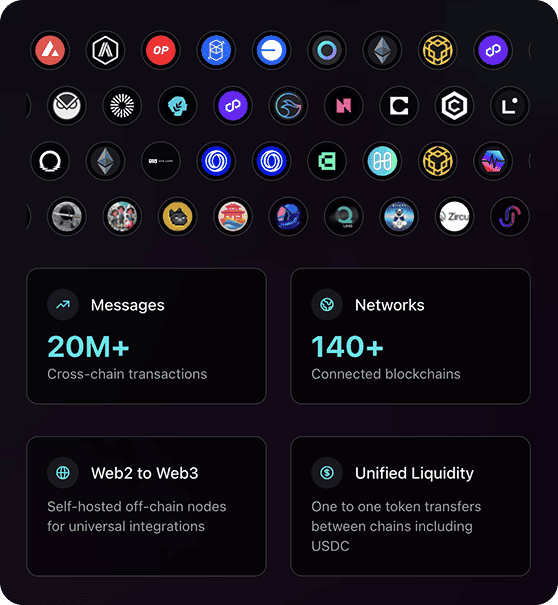
VIA Labs set out to solve one of Web3’s messiest problems: how to route assets across blockchains that don’t speak the same language.
The Cheesecake Labs team came on board to help connect VIA Labs’ protocol with Stellar, Cardano and Midnight — none of which fit neatly with EVM standards.
From EVM roots to a truly omni‑chain network
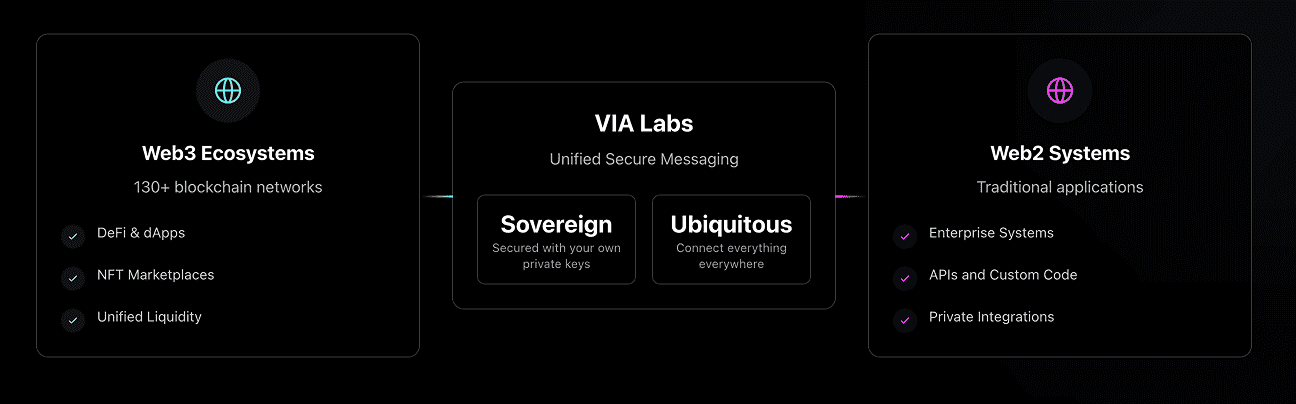
They're building the infrastructure layer for cross-chain communication, connecting 140+ public and private networks with direct contract-to-contract messaging.
When it secured a grant to integrate Stellar and partnered with Cardano’s privacy-focused sidechain Midnight, the project entered a new proving ground: Could EVM principles stretch across non-EVM terrain?
The interoperability wall
VIA Labs needed to relay messages, tokens, and NFTs between EVM-based chains and these new integrations. But each ecosystem has fundamentally different ways of processing and verifying transactions.
Three protocols, zero common ground
Cardano uses validators built for the UTxO model, and Stellar uses WASM-based smart contracts. Neither maps easily to EVM.
Stellar uses Ed25519 signatures, EVM chains use ECDSA and Cardano’s privacy layer adds zero-knowledge proofs — systems that can’t natively verify one another.
Each chain records and validates data differently. Without normalization, a message from one network reads as gibberish on another.
More than a technical project
Integrating Stellar and Cardano wouldn’t just untangle one of blockchain’s biggest technical knots. It was also central to VIA Labs’ long-term strategy.
It would open the protocol to new ecosystems, make onboarding easier for developers, and ultimately make VIA Labs impossible to ignore in cross-chain conversations.
They had the architecture and the protocol, but their engineering team needed help enabling cross-chain communication at the system level. They chose Cheesecake Labs to help them sync the unsyncable.
Cheesecake Labs joins the build
We dove straight in from the first commit. Our team worked shoulder to shoulder with their engineers to pinpoint exactly where each system conflicted at the protocol level, and then decided what to abstract and what to translate.
Modular structure
Each component was designed for reuse, cutting future chain integration time by more than 50%.
Engineered for trust
Each signature scheme and message flow was reviewed for compliance and cryptographic integrity before being wired into the system.
One logic, any chain
To make development easier, we built abstraction layers that absorbed each chain’s quirks. That meant both teams — and future ones — could add new integrations without touching core logic.
Engineering cross-chain reality
Every layer of interoperability had to be re-engineered from scratch.
Stellar ↔ EVM
Stellar’s XDR format and two-step WASM deployment didn’t mesh with EVM logic. We built an orchestration layer that interprets Stellar events in real time and triggers the appropriate actions on the EVM side, enabling both networks to operate as one.
Issue
Build response
Incompatible address formats (base32 vs. hex)
Address converter for consistent identity mapping
Signature mismatch (Ed25519 vs. ECDSA)
Signature translation layer to verify both securely
Event and transaction encoding conflicts (XDR vs. ABI)
Event normalization engine to parse and standardize logs
Different deployment flows (two-step WASM vs. single-step bytecode)
Unified deployment interface for both systems
Fee model differences (fixed bump vs. gas)
Fee abstraction layer to calculate costs uniformly
Diverging security checks
Multi-scheme validation layer to prevent mismatch or bypass
RPC/config fragmentation
Shared configuration and RPC interface
Error handling gaps
Error normalization system with structured recovery logic
No cross-chain test harness
Deterministic end-to-end test suite for multi-chain validation
Cardano + Midnight ↔ EVM
Cardano’s UTxO model and Midnight’s zero-knowledge layer leave no straightforward way to coordinate transactions — or even to detect when one happens. To preserve cross-chain logic without direct calls or logs, we helped VIA Labs rebuild their architecture, using Lucid and Aiken to keep the system auditable and private at the same time.
Issue
Build response
No cross-contract calls
Transaction batcher to simulate EVM-style sequences
Ledger model mismatch (UTxO vs. account-based)
Off-chain orchestration layer to sync states reliably
Lack of shared storage
Datum-based storage to maintain cross-chain context
No native event logs
Event triggers by tracking Datum changes and metadata signals
Tech stack at a glance
Chains connected
Stellar, EVM, Cardano, Midnight
Contract frameworks
Soroban (Stellar), Aiken (Cardano)
Key SDKs
Stellar SDK, Lucid (Cardano)
Infra tools
Abstraction layers + cross-chain test suite
Languages used
Rust (contracts), Aiken (validators), JavaScript (coordination)
Cross-chain, uncompromised
VIA Labs has achieved something most cross-chain systems rarely pull off: it works exactly as promised, consistently and verifiably.
Both the Stellar Community Fund and Cardano’s privacy ecosystem validated the project, putting VIA Labs on the map as a new reference point for practical interoperability.

Here’s what VIA Labs had to say about our work together.
“Working alongside Cheesecake Labs has been a seamless experience from onboarding through delivery. Their team is professional, curious, and highly adaptive — always quick to meet our cross-chain needs, even when the targets evolve mid-flight. They’ve become an extension of our own engineering culture at VIA Labs.”

Robert (Cletus) Pilat
COO @ VIA Labs
Build better blockchains with Cheesecake Labs.
Build better blockchains with Cheesecake Labs.
Have an idea for the next great blockchain innovation? We’re ready to help you bring your dreams to life. Get in touch today!